
Emerald Cut Diamond Guide
Nothing says glamour and sophistication quite like an emerald cut gemstone. The vintage appearance of these diamonds evoke the intriguing aesthetic of “the roaring 20s” – think champagne, jazz, and Art Deco. Although less light reflects from an emerald cut diamond than from a brilliant cut diamond, the parallel facets of an emerald cut diamond create illusions of depth and magical “mise en abyme” effects, as if two mirrors are reflecting one another endlessly.

The Emerald Cut Diamond
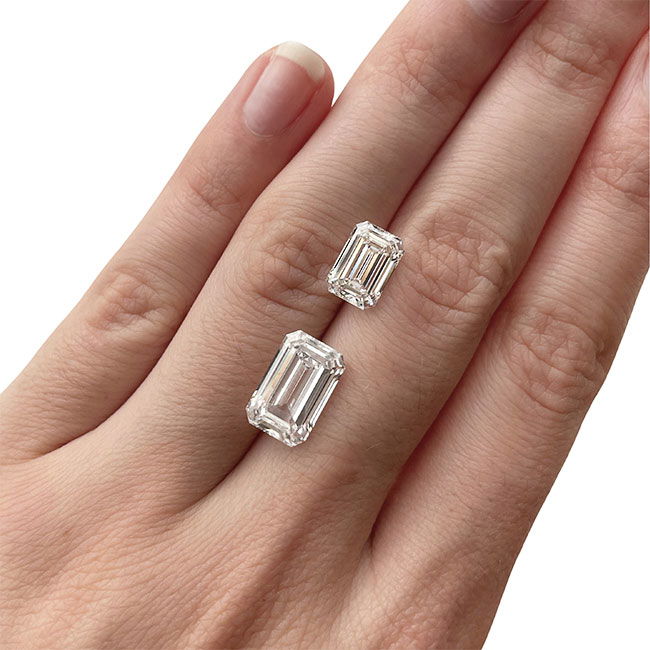
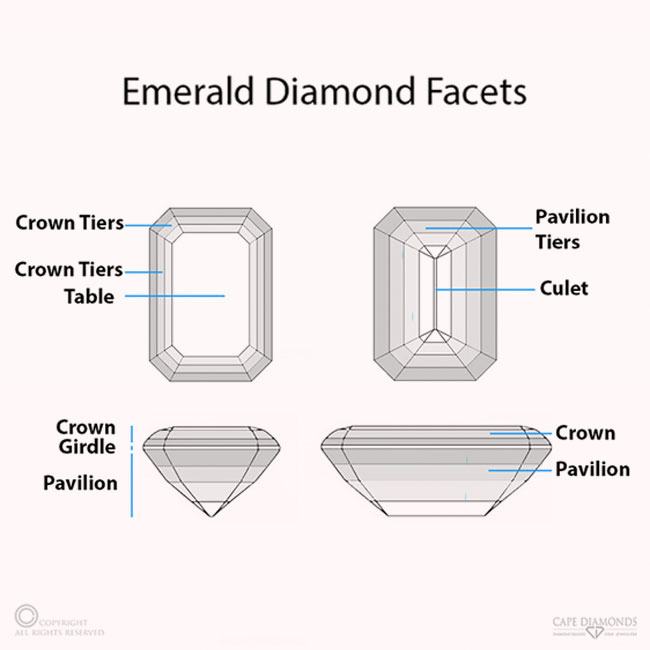
The emerald cut is a rectangular step-cut, meaning its main facets on the crown and pavilion are cut in tiers or ‘steps’ parallel to the girdle of the stone. The beveled corners make the stone unlikely to chip or crack, resulting in an emerald cut diamond (as seen from above) actually having eight sides. The rectangular cut is known for being exceptionally flattering to all hand-shapes, making one’s fingers appear more elegant and elongated.
Certification
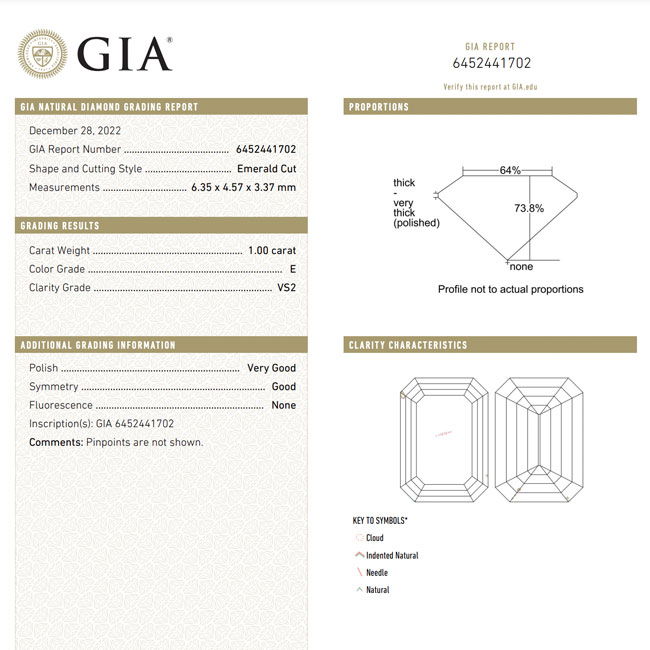
Like all diamonds you purchase at Cape Diamonds, you will receive a GIA certificate for your emerald cut diamond. The diamond will have a unique number lasered onto its girdle, matching it to the GIA certificate. On the certificate, the emerald cut diamond is not graded specifically for “cut” quality by GIA laboratories – this means that you need to be mindful of a number of factors when selecting a stone of this shape.

Clarity
Emerald cut diamonds cost significantly less per carat than brilliant cuts, but because of the clear, linear, and relatively unobstructed planes of light within the stone, small defects will be more visible. The table size of an emerald cut diamond is much larger than any other stone. This creates a large window enabling you to look into the diamond.
Emerald cut diamonds require some research to understand proportions, value and sparkle to ensure the perfect investment. Looking at the GIA certificate will give you a guideline about inclusions such as “feathers” or chips, but seeing the certificate is not enough. You must actually see the diamond, or a detailed photograph of the diamond, before purchase, to make sure that it has no obviously visible inclusions. This photo shows a black crystal imperfection in the middle of the emerald cut diamond. The single black spot is reflected all around the stone by the parallel facets of the emerald cut.
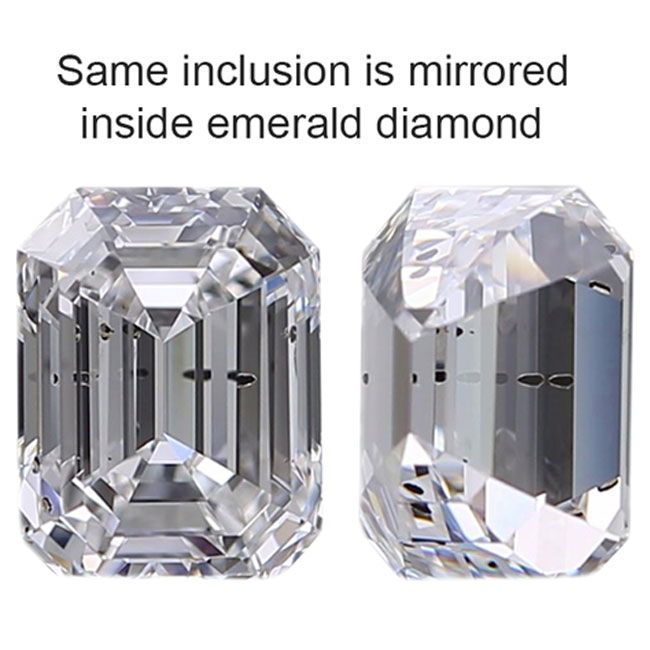
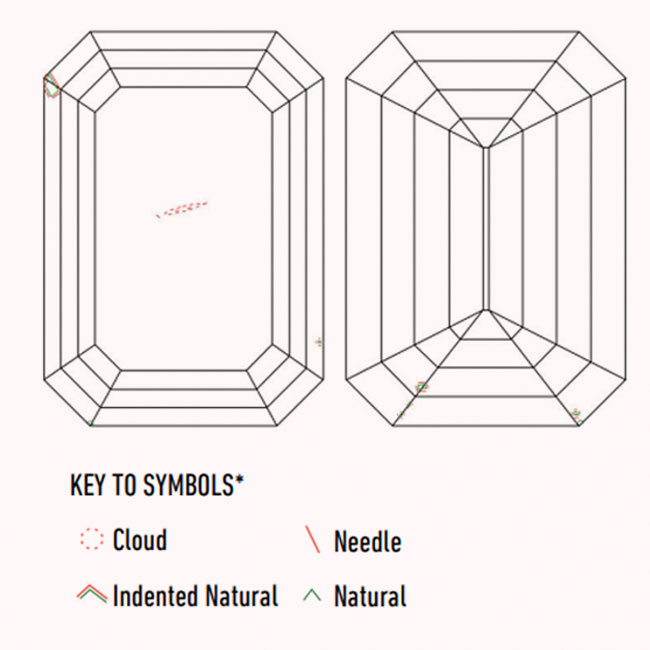
Be sure to avoid emerald cut diamonds with marks in the middle. If you going to purchase an emerald cut with less clarity be sure the inclusions are on the sides and preferably white. It is therefore worthwhile to find an emerald cut diamond with greater clarity and no noticeable inclusions. Clarity Vs1 – Vs2 and above are the best choices for emerald cut diamonds to ensure no unforeseen problems with your purchase.
Colour
Similarly, the colour of an emerald cut diamond is more noticeable than in a brilliant cut, which can mask colour to some extent with its fire and scintillation. Thus it is worth choosing an emerald cut with a better colour grade than if you were looking for a brilliant cut diamond. Unless you are going for a fancy colour, you will want your emerald cut diamond to be as close to colourless as can be. Since the emerald cut diamond costs less per carat than a brilliant cut, you can afford to spend more on the clarity and colour quality of an emerald cut diamond. Cape Diamonds has a great selection of emerald cut stones with colour D-H and clarity Vs1- Vs2.
Polish and Symmetry
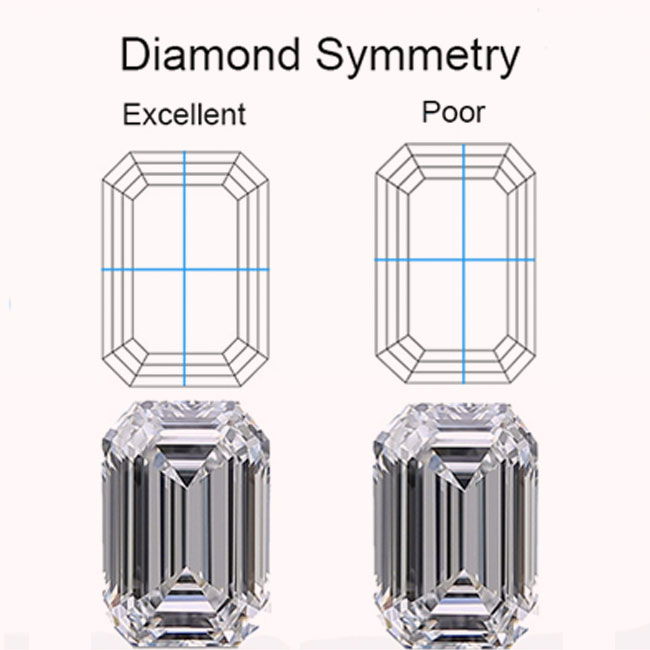
Because flaws are more visible in an emerald cut diamond, polish and symmetry are very important aspects. For all diamonds, GIA laboratories grade these factors under 10x magnification. Noticeable or numerous man-made scratches, “burns”, nicks and scratches, created during the polishing process, will result in a low grading for polish. The large table of the emerald stone makes these polishing and surface imperfections more visible to the human eye. Always be sure that your emerald stone has a very good or excellent polish. Avoid emerald stones with fair to poor polishes.
Table Percentage
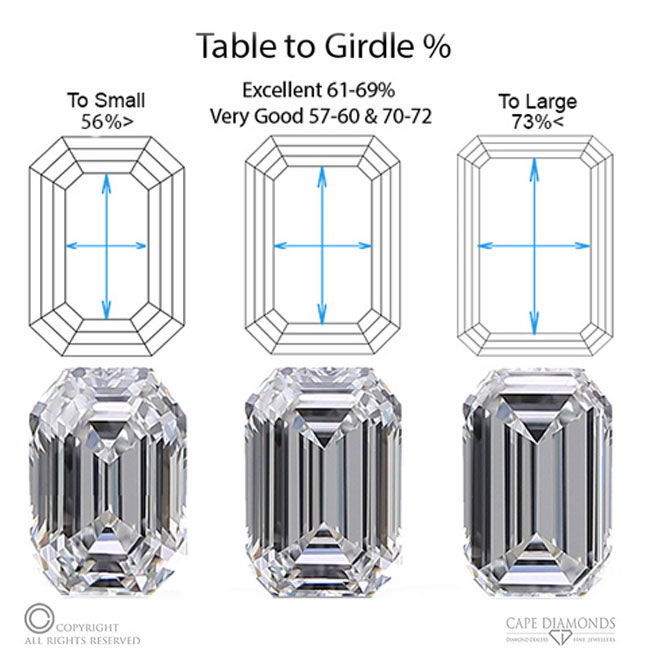
The table of an emerald cut diamond is the main window into the wonderful world of mirrors that is the hallmark of this precious gemstone. A good-sized table percentage, relative to girdle width, is important. The ideal table ratio to girdle width of round brilliant cut diamonds is between 54% – 60%, while excellent dimensions for an emerald cut diamond are a table to girdle ratio between 61% – 69% and very good will be between 57% – 60% and 70% – 72%. When the table is too large the diamond looks too flat and when the table is too small the elegance of the emerald stone is lost.
Depth Percentage
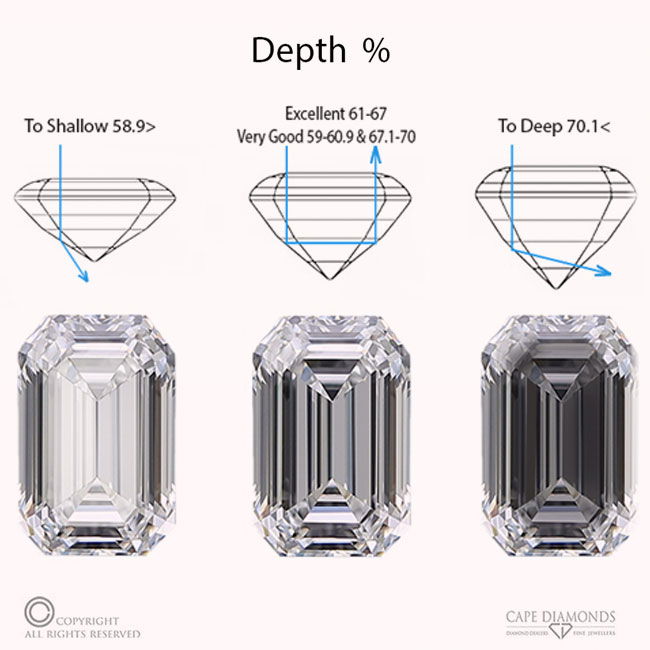
Furthermore, the depth percentage, relative to the girdle width, should not be too much less than the table percentage, otherwise you will lose out on that beautiful optical depth. If the depth percentage is higher than the table percentage, make sure that the table is spacious enough as an aperture into the stone. Similar to other diamond shapes the depth percentage to girdle ratio should not be too little or too great. Excellent depth percentages are 61%-67 % and very good would be 59%-60.9% or 67.1%-70%. Avoid diamonds with depths that are excessively deep as the stone will look dark and when too shallow the stone will be see-through and not be a perfect mirror.
Length to Width Ratio
This really depends on your preference, though you would not want the stone to look too square or too long. Emerald cut diamonds with a ratio of less than 1:3 look fat on the finger. Stones that have proportions of 1:4 are the most beautiful but are harder to find as only a specific rough diamond crystal will yield such a stone. A ratio of 1:5 is also attractive in an emerald diamond, but it may look a little on the long side. Try to avoid stones with a ratio of more than 1:5. Cape Diamonds recommends emerald diamonds with a ratio of 1:4 as the best investment.

Facets
The number of facets will depend on the number of tiers stepping up and down from the girdle of the diamond. Emerald cut diamonds often have 2 to 3 steps in the crown, and another set of 3 to 4 tiers in the pavilion. They can have up to 57-58 facets, with 25 of these on the crown, 8 on the girdle, and 24 or 32 on the pavilion excluding a possible culet. Cape diamonds stock emerald cut diamonds with 4 tiers or more on the pavilion to ensure maximum sparkle and scintillation. That means our emerald cut stones have at least 65 facets, keeping us a cut above the rest.
History
The emerald cut dates back at least to the sixteenth century. As the name suggests, this shape was developed as a way of sculpting emeralds for jewellery so that they would be less likely to chip or break, as emeralds are much softer and less resilient than other gemstones. The large rectangular facets also allowed for a greater depth of gaze into the gleaming green translucency of the emerald. Because of the classic beauty of the shape, the technique was then adapted to cutting other stones, including diamonds. Today emerald cut diamonds are among the most rare and unique of diamond cuts, though they retain classic popularity.

Setting
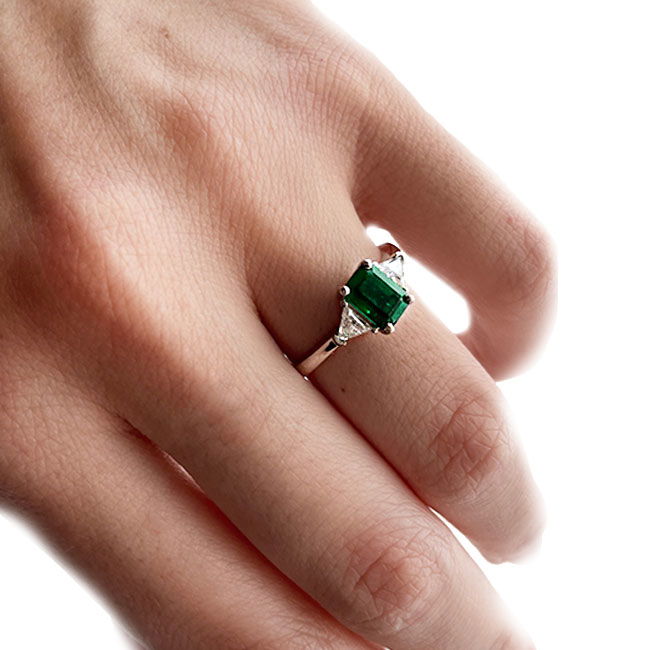
Surrounded by a halo of smaller diamonds, or flanked by tapered baguettes, an emerald cut diamond ring is going to be stunning. An emerald cut solitaire on a plain band, or on a band encrusted with smaller diamonds will look glamorous and sophisticated. A solitaire emerald cut diamond makes a perfect companion for wedding ring, or for an eternity band or two. Rather, the tiered facets must be cut straight and parallel to one another, in a step-like formation. The best symmetry selection for emerald diamonds is excellent to very good.
South Africa's Most Trusted Jeweller

Most 5 Star Reviews in South Africa
Trip Advisor

Rated No1 Retail Store in Cape Town
