
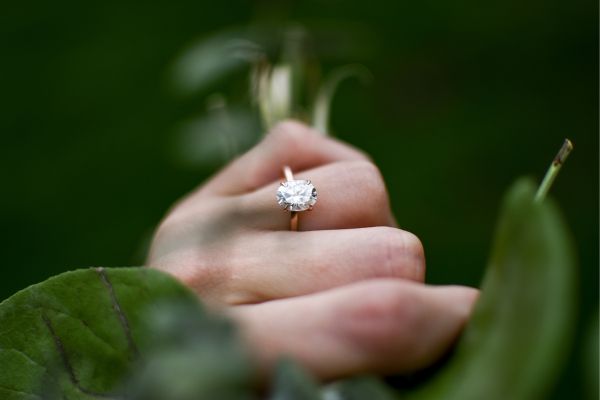
With celebs and TikTok influencers flashing their engagement rings at every chance, the range of styles out there is overwhelming. While you probably have a Pinterest board full of ideas and some idea of styles you like, one of the biggest factors to consider when making your choice is the overall size. There are three main sizes when it comes to rings. Delicate, standard, and chunky. Most rings will fall within these sizes. Delicate rings have a thinner, finer band. Standard rings have a medium band and are used in the majority of designs. Chunky rings have a wider band that is also often thicker. Each size has its own pros and cons. Ultimately, the decision comes down to your lifestyle and style preference, but your budget may also come into play.
In this guide, we’ll take a look at these three sizes to see which engagement ring option is the right choice for your needs, and give you some tips on how to decide which is best.
Which is the Best Size for Your Engagement Ring?
Here are a few things to keep in mind when considering sizes for your custom engagement ring design.
Delicate rings
As the name implies, these rings are delicate and minimal. The bands are thinner, and the designs are often more subtle. Styles that work well with thinner bands include bezel, pear, tiara, marquise, toi et moi, cluster, solitaire, swirl, twisted band, criss-cross, and wrapped bands. They work well in any metal, but rose gold can be especially good as it adds to the feminine, soft look of these rings.
The upside to these engagement rings is that they go with other jewellery, especially with bands that can be easily layered. They are subtle, making them ideal for brides who do not typically wear a lot of jewellery. The designs are often understated, allowing you to add contemporary elements without the ring looking too over the top.
The downside is that many settings feature added detail that enhances the fine bands. Clusters and tiaras can have settings that catch on clothing more easily. These rings may be more prone to wear and tear, as the bands are much finer than regular bands. If you have a busy, active lifestyle, they may not be the best choice.
Standard rings
The majority of rings have a medium band. That means that the bands are not too thin and not too thick. They work in pretty much every design, whether you prefer simple solitaires or modern clusters. They work well with any metal, too. As they have a standard size, they suit every hand size, as long as you choose a flattering design. They can be used in two-town metal designs. This makes them extremely versatile.
The upside to medium engagement rings is their versatility. Whatever style you prefer, this band is a good choice. They can be as simple or bold as you choose. They work with pave bands as well as halo designs. They have a classic look that will never date, meaning that they are always future-proof as long as you choose a design that is timeless rather than ‘trend of the day’.
The downside is that they can be on the boring side for those wanting something different. Some brides prefer the more understated look of delicate bands, while others prefer bolder rings that make more of a statement. These rings can also be a little harder to layer, depending on the design. Adding layers can make the ring look too large. Stones also need to balance the thickness of the band, which means that small stones may not work as well unless you’re choosing a three or five-stone ring or cluster.
Chunky rings
Chunky or larger rings are wider and thicker than average. These rings are ideal for brides wanting to make a statement, but they’re not always ideal in every design. With the right design and right stones, they can make a big style statement. Chunky rings work best with smaller stones or styles set into the band, such as thick shank, pave, three and five-stone, swirl, twists, criss-cross, flush set, and channel set.
The upside is that the rings are definitely not boring. With the right setting, they are unconventional, contemporary, bold and beautiful. They work well in any metal, with any stone. As the majority have smaller stones rather than single, larger stones, they can be a cost-effective option.
The downside is that these engagement rings can be overpowering if the wrong setting is chosen. Large stones on a thick band can make your hand look small. Settings such as prong settings can add height, which adds to the size. Stones that have too much of a contrast to the band can throw off the balance.
Whichever style you prefer, we are here to help bring your ideas to life. Contact Cape Diamonds, and we’ll work with you to plan your perfect engagement ring.